Astronomy, Astrophysics, and Cosmology : How They Shape Our Understanding of the Universe !
Curious about the universe? This blog explores the fascinating worlds of astronomy, astrophysics, and cosmology—highlighting their key differences, famous...
By Propagation Team on 3/5/2025
- Astronomy
- Astrophysics
- Cosmology
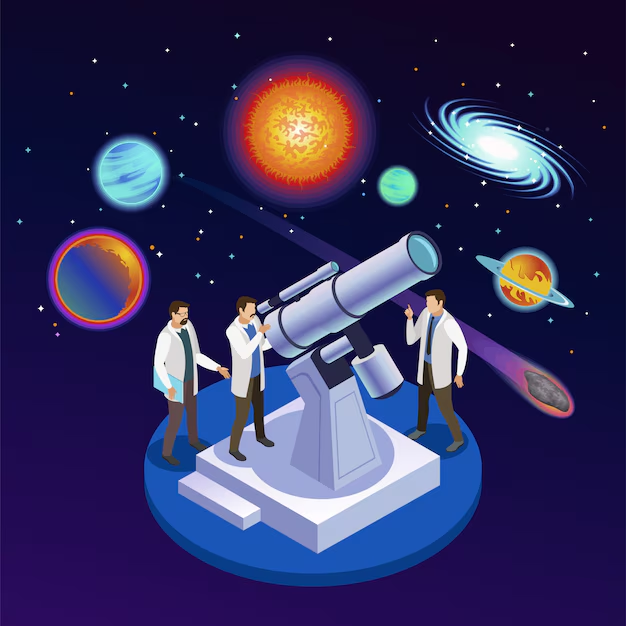
The universe has captivated human curiosity for millennia. From early stargazers who charted the night sky to modern-day scientists decoding the Big Bang, our quest to understand the cosmos has led to the emergence of three closely related but distinct fields: astronomy, astrophysics, and cosmology. Though they often overlap, each discipline has its unique scope, tools, and goals. In this post, we’ll delve into what sets them apart, what unites them, and the remarkable minds that have advanced our knowledge of the universe.
Astronomy: The Oldest Natural Science
Astronomy is one of the oldest sciences, rooted in humanity’s early efforts to observe and understand the sky. Traditionally, it involves the observation and classification of celestial objects such as stars, planets, comets, galaxies, and nebulae.
Ancient civilizations like the Babylonians, Greeks, Mayans, and Indians used astronomy for practical purposes—calendars, navigation, and agriculture. Even today, amateur astronomers continue this tradition with telescopes in their backyards.
Key Areas in Astronomy:
Observational Astronomy: Using telescopes and instruments to gather data.
Planetary Astronomy: Studying planets in and outside our solar system.
Stellar Astronomy: Investigating stars and their life cycles.
Galactic and Extragalactic Astronomy: Exploring galaxies and the large-scale structure of the universe.
Astrophysics: The Physics of the Universe
While astronomy catalogs and observes, astrophysics seeks to explain. It applies the laws of physics and mathematics to understand the behavior, structure, and evolution of astronomical objects.
In essence, astrophysics is the theoretical engine behind astronomy. For example, while astronomers may observe a star's brightness and composition, astrophysicists develop models to explain nuclear fusion in its core, or the mechanics of a supernova.
Major Subfields of Astrophysics:
Theoretical Astrophysics: Uses mathematical models to predict phenomena.
High-Energy Astrophysics: Studies cosmic rays, black holes, and neutron stars.
Relativistic Astrophysics: Focuses on phenomena involving Einstein’s theory of relativity.
Astroparticle Physics: Bridges particle physics and astrophysics (e.g., neutrinos, dark matter).
Cosmology: The Study of the Universe as a Whole
Cosmology is a branch of astrophysics that deals with the origin, structure, evolution, and eventual fate of the entire universe. It addresses the "big questions": How did the universe begin? What is it made of? How will it end?
Modern cosmology emerged with Albert Einstein’s General Theory of Relativity and was revolutionized by the discovery of the expanding universe and the cosmic microwave background radiation.
Core Concepts in Cosmology:
The Geometry and Fate of the Universe
" While astronomy looks at what’s out there, and astrophysics explains how it works, cosmology asks why the universe is the way it is. "
Famous Scientists Who Shaped These Fields :
Galileo Galilei (1564–1642) – Often called the "Father of Modern Astronomy," Galileo was among the first to use a telescope for celestial observation, discovering Jupiter’s moons and phases of Venus.
Isaac Newton (1643–1727) – Developed the laws of motion and gravity, laying the foundation for classical mechanics and celestial dynamics.
Edwin Hubble (1889–1953) – Proved that the universe is expanding, leading to the formulation of Hubble's Law and paving the way for Big Bang cosmology.
Albert Einstein (1879–1955) – His theory of general relativity transformed our understanding of gravity and became a cornerstone of modern cosmology.
Stephen Hawking (1942–2018) – Made groundbreaking contributions to black hole physics and quantum cosmology, popularizing science through books like A Brief History of Time.
Vera Rubin (1928–2016) – Provided strong evidence for dark matter through her study of galaxy rotation curves.
Why These Fields Matter :
The importance of these sciences goes beyond academic curiosity. Astronomy inspires awe and expands our perspective. Astrophysics drives innovation in imaging, data analysis, and particle physics. Cosmology challenges our understanding of time, space, and existence itself.
Moreover, technologies developed for space and cosmic research have led to practical applications—from GPS and satellite communication to medical imaging.
Conclusion :
Astronomy, astrophysics, and cosmology each offer a unique lens through which we view the universe. Astronomy observes the stars, astrophysics explains their inner workings, and cosmology reveals the grand narrative of the cosmos. Together, they form the foundation of our cosmic understanding, continually pushing the boundaries of human knowledge.
Whether you’re an amateur stargazer or a future theoretical physicist, these fields invite you to join the greatest adventure of all—understanding our place in the universe.