A Life Among the Stars: Remembering James A. "Jim" Lovell Jr.
In the vast tapestry of human exploration, few names shine as brightly as James Arthur "Jim" Lovell Jr., whose remarkable journey took him from the prairies...
By Propagation Team on 9/8/2025
- Physics
- AI
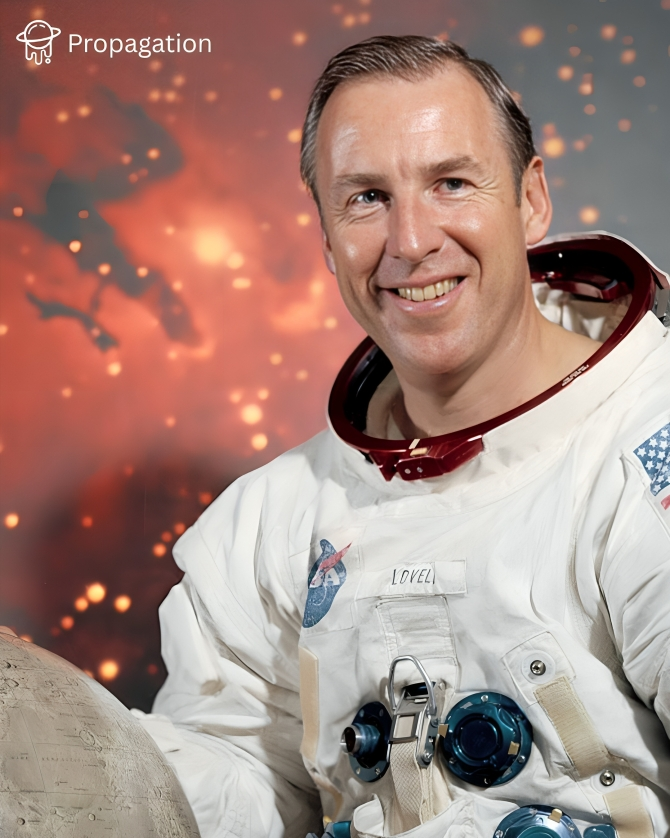
Born on March 25, 1928, Jim Lovell entered the world during an era when flight itself was still considered miraculous, let alone the possibility of journeying to the moon. Growing up in Cleveland before his family moved to Milwaukee, Wisconsin, young Jim was captivated by the mysteries of the sky above. His fascination with aviation would prove to be more than childhood wonder—it was a calling that would shape not only his own destiny but the course of human spaceflight itself.
Lovell's path to the stars began with a deep commitment to service and education. After graduating from Juneau High School in Milwaukee, he enrolled at the University of Wisconsin-Madison, where he studied engineering while participating in the Naval Reserve Officer Training Corps. However, his academic journey took a decisive turn when he received an appointment to the United States Naval Academy in Annapolis, Maryland. There, surrounded by the storied traditions of naval service, Lovell honed not only his intellectual abilities but also the qualities of leadership, discipline, and calm under pressure that would later serve him so well in the unforgiving environment of space.
Following his graduation from the Naval Academy in 1952, Lovell embarked on a distinguished career as a naval aviator. He served with honor during some of the most challenging periods of the Cold War, flying missions that demanded precision, courage, and unwavering dedication. His time in the Navy was marked by a progression through increasingly responsible positions, including service as a test pilot—a role that placed him at the cutting edge of aviation technology and prepared him for the rigorous demands of spaceflight.
The late 1950s and early 1960s brought an electrifying new frontier to America's consciousness: space exploration. As the nation committed itself to President Kennedy's audacious goal of landing on the moon before the decade's end, NASA began searching for a special breed of individual—test pilots with the technical expertise, physical fitness, and psychological fortitude to venture into the unknown reaches beyond Earth's atmosphere. Jim Lovell was among this select group, and in 1962, he was chosen as part of NASA's second group of astronauts, known as the "New Nine."
Lovell's introduction to spaceflight came through the Gemini program, NASA's crucial stepping stone between the pioneering Mercury flights and the ambitious Apollo lunar missions. His first journey beyond Earth's atmosphere began on December 4, 1965, when he launched aboard Gemini 7 alongside command pilot Frank Borman. This mission was groundbreaking in its scope and duration, requiring the crew to remain in the cramped confines of their spacecraft for an unprecedented fourteen days. The mission served multiple critical purposes: demonstrating that humans could survive the extended periods in space necessary for lunar missions, conducting the first orbital rendezvous between two crewed spacecraft when Gemini 6A approached within one foot of their capsule, and proving that the effects of long-duration spaceflight would not prevent astronauts from accomplishing complex tasks.
The success of Gemini 7 established Lovell as one of NASA's most capable astronauts, and he was selected for another Gemini mission that would prove equally significant. On November 11, 1966, Lovell served as command pilot for Gemini 12, the final flight of the Gemini program. Alongside pilot Edwin "Buzz" Aldrin, who would later become the second person to walk on the moon, Lovell helped conclude the Gemini program on a triumphant note. This mission was particularly notable for Aldrin's successful completion of multiple spacewalks, finally solving the problems that had plagued previous attempts at extravehicular activity and proving that astronauts could work effectively outside their spacecraft—a capability essential for the upcoming lunar missions.
As the Gemini program drew to a close, Lovell found himself selected for what would become one of the most historically significant missions in human history. Apollo 8, launched on December 21, 1968, carried Lovell, Frank Borman, and William Anders on humanity's first journey to another celestial body. Originally planned as an Earth orbital test of the lunar module, the mission was audaciously redesigned to circumnavigate the moon after delays in lunar module development and intelligence suggesting Soviet plans for their own lunar flyby.
The Apollo 8 mission captured the world's imagination like few events before or since. As command module pilot, Lovell played a crucial role in navigating the spacecraft on its quarter-million-mile journey to the moon. The mission achieved numerous firsts: the first humans to leave Earth orbit, the first to see the far side of the moon with their own eyes, and the first to witness the iconic "Earthrise" over the lunar horizon. "Apollo 8 was the high point of my career. As a matter of fact, it was the high point of our manned space efforts. Not so much in a technical way but in an emotional way," Lovell would later reflect, recognizing the profound impact the mission had during the tumultuous year of 1968.
The mission's Christmas Eve broadcast from lunar orbit, in which the crew read from the Book of Genesis while Earth appeared as a small blue marble in the cosmic void, became one of the most watched and emotionally resonant moments in television history. For many, it represented a moment of unity and wonder during a year marked by war, social upheaval, and national division. Lovell's calm, professional demeanor and obvious competence helped reassure a watching world that humanity was capable of achieving the seemingly impossible.
Following the triumph of Apollo 8, Lovell was selected to command Apollo 13, originally intended as the third lunar landing mission. Launched on April 11, 1970, with crew members John "Jack" Swigert and Fred Haise, the mission was meant to explore the Fra Mauro highlands of the moon. However, fate had other plans, and Apollo 13 would instead become a testament to human ingenuity, teamwork, and leadership under the most extreme circumstances imaginable.
Approximately 56 hours into the mission and 200,000 miles from Earth, an explosion in one of the service module's oxygen tanks transformed what should have been a routine flight into a life-or-death struggle for survival. The now-famous words "Houston, we've had a problem" marked the beginning of one of the most remarkable rescue operations in human history. As commander, Lovell faced an unprecedented challenge: bringing his crew home safely in a crippled spacecraft with limited power, water, and breathable air.
Lovell's leadership during the Apollo 13 crisis revealed the true measure of the man. Rather than succumb to panic or despair, he methodically worked with his crew and mission control to solve problem after problem, each one potentially fatal if not addressed correctly. The lunar module, originally designed to support two people for two days on the lunar surface, had to be reconfigured to support three people for four days while serving as a lifeboat. Power had to be conserved to ensure the command module could be restarted for reentry. Carbon dioxide had to be scrubbed from the air using makeshift filters. Navigation had to be accomplished using manual star sightings and the Earth's terminator line.
Through it all, Lovell demonstrated the calm professionalism and steady leadership that had brought him to space in the first place. His ability to maintain composure while making critical decisions under extreme stress inspired not only his crewmates but also the thousands of people working around the clock on the ground to bring them home. The successful return of Apollo 13, with the command module splashing down safely in the Pacific Ocean on April 17, 1970, transformed what could have been NASA's greatest tragedy into perhaps its finest hour.
The Apollo 13 mission, initially viewed as a failure because it did not achieve its lunar landing objective, instead became a powerful symbol of human resilience, ingenuity, and cooperation. Lovell's role as commander during this crisis cemented his place not just in the history of space exploration but in the broader story of human achievement in the face of seemingly insurmountable odds. His calm professionalism under extreme pressure became a model for crisis leadership that continues to be studied and emulated decades later.
Beyond his technical competence and professional achievements, those who knew Jim Lovell spoke consistently of his personal qualities: his humility despite his extraordinary accomplishments, his dedication to his family, his commitment to inspiring young people to pursue careers in science and engineering, and his deep understanding of the broader significance of space exploration for humanity. He possessed that rare combination of technical brilliance and emotional intelligence that enabled him to excel not only as an individual performer but as a leader of others in high-stress, high-stakes situations.
Following his retirement from NASA and the Navy in 1973, Lovell continued to serve as an ambassador for space exploration, sharing his experiences through speaking engagements, books, and media appearances. His 1994 book "Lost Moon," co-authored with Jeffrey Kluger, provided a detailed account of the Apollo 13 mission and served as the basis for Ron Howard's acclaimed 1995 film "Apollo," which introduced Lovell's story to new generations and featured Tom Hanks in the role of the veteran astronaut.
Lovell's influence extended far beyond his own missions and immediate circle. His example helped establish the template for what it meant to be an astronaut: technically proficient, psychologically resilient, physically courageous, and morally committed to the success of the mission and the safety of the crew. Young people inspired by his story pursued careers in science, technology, engineering, and mathematics, contributing to advances that continue to benefit society today. His emphasis on teamwork and preparation influenced not only NASA's culture but also management practices in industries far removed from space exploration.
Throughout his later years, Lovell remained actively engaged with the space program, witnessing the development of the Space Shuttle, the construction of the International Space Station, and the emergence of commercial spaceflight companies. He saw his legacy carried forward by new generations of astronauts who ventured not only to low Earth orbit but also prepared for humanity's return to the moon and eventual journey to Mars. His perspective as one of only 24 humans to have journeyed to the moon provided valuable historical context for these new endeavors.
The personal cost of Lovell's extraordinary career should not be overlooked. Like many astronauts of his generation, he spent extended periods away from his family while training for missions that carried significant risk. His wife Marilyn and their children lived with the constant awareness that each mission might be his last, a burden that families of test pilots and astronauts understand all too well. Yet Lovell's commitment to his family remained as strong as his commitment to the space program, and his marriage to Marilyn lasted more than six decades, a testament to their mutual dedication and love.
As the years passed and the number of living Apollo astronauts dwindled, Lovell became an increasingly precious link to one of humanity's greatest achievements. His presence at NASA events, space anniversaries, and educational programs served as a living reminder of what humans can accomplish when they commit themselves to goals that seem beyond reach. His stories, told with the modesty and precision that characterized his approach to everything, inspired audiences to believe that they too might achieve extraordinary things.
Jim Lovell's passing on August 7, 2025, at the age of 97, marks the end of an era, but his legacy extends far beyond his own remarkable achievements. He helped prove that humans could survive and work in the harsh environment of space, that they could travel to other worlds and return safely, and perhaps most importantly, that they could overcome seemingly impossible challenges through teamwork, preparation, and steady leadership. His life embodied the best qualities of the generation that took humanity's first steps beyond Earth: technical competence wedded to personal integrity, individual excellence combined with team commitment, and the rare ability to remain humble in the face of extraordinary achievement.
The story of Jim Lovell is ultimately a story about the power of human potential. From a young man fascinated by flight to a seasoned commander navigating by starlight to bring his crew home safely, his journey reminds us that ordinary people can accomplish extraordinary things when they dedicate themselves to worthy goals and refuse to surrender in the face of adversity. His legacy lives on not only in the technical achievements of the space program but in the inspiration he provided to countless individuals who learned from his example that with preparation, dedication, and courage, even the most daunting challenges can be overcome.
As we remember Jim Lovell, we remember not just an astronaut or a naval officer or a test pilot, but a human being who expanded the boundaries of what it means to be human. His footprints may not have touched the lunar surface, but his journey helped pave the way for those who did walk on the moon and for those who will venture even farther in the years to come. In the vast cosmos that he explored, Jim Lovell's greatest achievement was not the distances he traveled but the example he set of how to navigate life's greatest challenges with skill, grace, and unwavering commitment to bringing everyone home safely.