Propagation Presents: Tonight’s Spectacular Blood Moon
Step outside tonight and prepare to witness one of nature's most breathtaking spectacles. The Moon, our faithful celestial companion, is about to transform...
By Propagation Team on 7/9/2025
- Space
What Exactly Is a Lunar Eclipse?
Imagine the Earth, Moon, and Sun playing a cosmic game of shadow tag. A lunar eclipse occurs when our planet slides perfectly between the Sun and the Moon, casting Earth's shadow across the lunar surface. Think of it like holding a ball in front of a flashlight in a dark room – the ball creates a shadow, and if you place another smaller ball in that shadow, it becomes darkened.
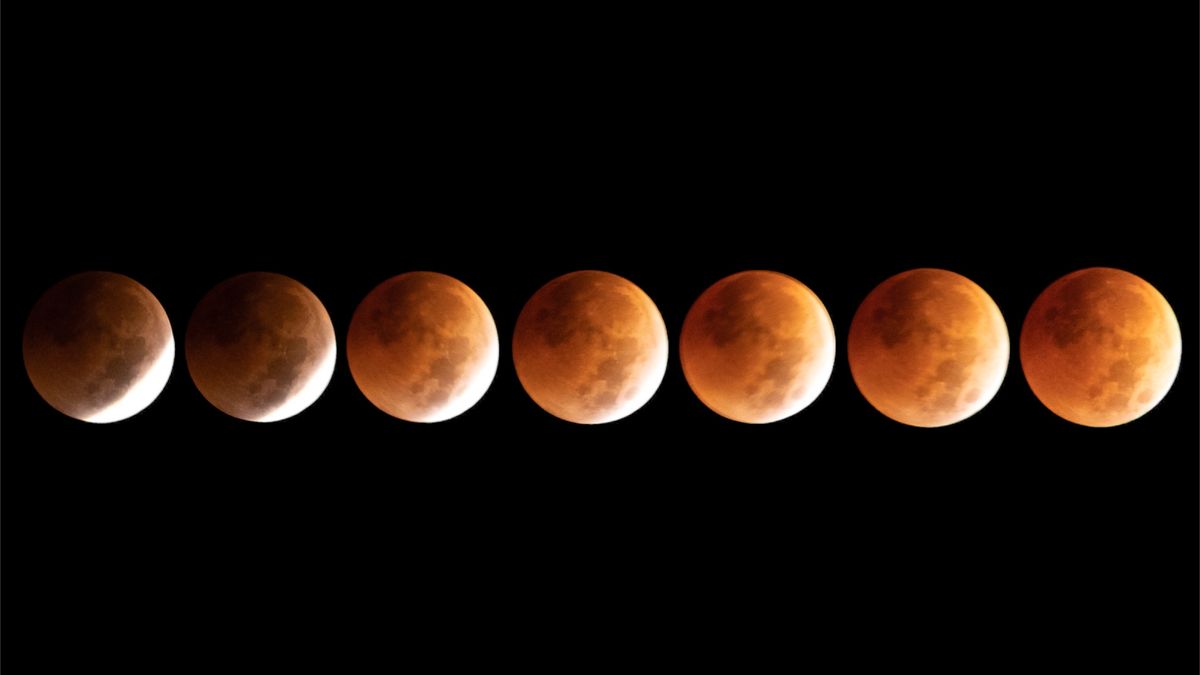
During tonight's event, the Moon will pass through Earth's shadow in space, causing it to gradually dim and then take on that famous reddish glow. Unlike a solar eclipse, where you need special glasses to look at the Sun, lunar eclipses are completely safe to observe with the naked eye. In fact, the darker it is around you, the better the show will be.
Total vs. Partial: Understanding the Difference
Not all lunar eclipses are created equal. A partial lunar eclipse happens when only a portion of the Moon enters Earth's shadow, creating the appearance that something has taken a bite out of our natural satellite. It's beautiful, but not quite as dramatic as what we're seeing tonight.
A total lunar eclipse, like the one occurring today, happens when the Moon passes completely through Earth's shadow, and tonight's eclipse will last an impressive 82 minutes in totality. During this time, instead of disappearing completely, the Moon transforms into a glowing ember hanging in the night sky. This total eclipse phase is the real showstopper – when photographers scramble for their cameras and children press their noses against windows in wonder.
The Mystery of the Blood Moon
Here's where things get truly fascinating. Why does the Moon turn red instead of simply going dark? The answer lies in Earth's atmosphere, which acts like a giant lens in space. When sunlight passes through our atmosphere, it gets bent and filtered. Blue light gets scattered away (the same reason our sky looks blue during the day), but red and orange light can sneak through and bend around Earth to still reach the Moon.
Essentially, every sunrise and sunset happening on Earth at that moment is casting its light onto the Moon's surface. Scientists can actually study Earth's atmospheric dust and aerosols by analyzing the exact shade of red the Moon displays during the eclipse. It's like the Moon becomes a mirror reflecting all of Earth's sunrises and sunsets simultaneously – a poetic thought that connects us to the broader cosmos.
Why Don't We See Eclipses Every Month?
You might wonder why, if the Moon orbits Earth once a month, we don't see lunar eclipses monthly. The answer lies in celestial mechanics. The Moon's orbit around Earth is tilted about 5 degrees compared to Earth's orbit around the Sun. Most months, the Moon passes slightly above or below Earth's shadow, like a ball rolling past the shadow of a larger ball rather than through it.
Only when the Moon's tilted orbit lines up perfectly do we get the celestial alignment needed for an eclipse. Total lunar eclipses happen roughly every two to three years for any given location on Earth, making tonight's event genuinely special.
Stories Written in Shadow and Light
Throughout human history, lunar eclipses have captured imaginations and inspired stories. Ancient civilizations often interpreted the blood-red Moon as an omen or the work of mythical creatures. In Norse mythology, it was believed that wolves were devouring the Moon. Ancient Mesopotamians thought demons were attacking their lunar deity.
The ancient Greeks were among the first to understand the true cause of lunar eclipses. The philosopher Aristotle used lunar eclipses as evidence that Earth was round – he observed that Earth's shadow on the Moon was always circular, which could only happen if Earth itself was spherical.
In many cultures, lunar eclipses were times for reflection, ceremony, and community gathering. Tonight, we continue that tradition, albeit with the advantage of scientific understanding that makes the event even more wondrous.
How to Watch Tonight's Eclipse Safely
The beauty of lunar eclipses is their accessibility. Unlike solar eclipses, you don't need any special equipment or safety precautions – just step outside and look up. The eclipse began at 8:57 PM and will peak between 11:00 PM and 12:22 AM local time, depending on your location.
For the best viewing experience, find a spot away from bright city lights with a clear view of the eastern sky. The Moon will be relatively high in the sky during totality, so you won't need to worry about trees or buildings blocking your view. Bring a comfortable chair or blanket, and perhaps some hot cocoa to keep warm.
While the eclipse is beautiful to observe with the naked eye, binoculars or a small telescope will reveal stunning details on the Moon's surface and enhance the dramatic color changes. If you're interested in photography, tonight offers an excellent opportunity to capture this celestial event with even a smartphone camera.
Watch for the subtle progression: the eclipse begins with a slight dimming on one edge of the Moon, gradually spreading across its surface like a slow-moving wave. During totality, notice how the Moon doesn't disappear but instead glows with that characteristic reddish-bronze light. The surrounding stars will appear brighter too, as the Moon's usual brilliance is temporarily subdued.
Connecting Earth to the Cosmos
As you watch tonight's eclipse unfold, take a moment to appreciate the extraordinary cosmic choreography happening above us. This event connects us to the fundamental forces that govern our solar system – gravity, orbital mechanics, and the interplay of light and shadow across hundreds of thousands of miles of space.
Lunar eclipses remind us that we're not just observers of the universe, but active participants in a cosmic dance that has been going on for billions of years. Every eclipse is a reminder of our planet's place in space and the delicate gravitational relationships that keep our solar system in motion.
Tonight's eclipse also represents the kind of predictable, observable phenomena that have driven human curiosity about space for millennia. The same spirit of wonder that led ancient astronomers to track lunar cycles and predict eclipses continues to fuel modern space exploration, from robotic missions to Mars to plans for lunar bases and missions to the outer planets.
As you watch the Moon transform tonight, you're participating in one of humanity's oldest shared experiences – looking up at the night sky and marveling at the cosmos. Whether you're a seasoned astronomer or someone just beginning to explore the wonders above, tonight's eclipse offers a perfect reminder of the incredible universe we call home.
Ready to explore more cosmic wonders? If tonight's lunar eclipse has sparked your curiosity about astronomy and space science, consider joining Propagation Academy's upcoming Winter School program. Our hands-on, engaging courses in astronomy, astrophysics, and space science are designed for students and enthusiasts of all levels who want to deepen their understanding of the universe. From telescope observations to space mission design, our Winter School offers an immersive journey into the cosmos. Visit our website to learn more about registration and discover how you can turn your fascination with events like tonight's eclipse into a deeper exploration of space science.