Marie Curie Biography: The Inspiring Life Story of Maria Salomea Skłodowska-Curie — The First Woman to Win Two Nobel Prizes
Celebrating the extraordinary journey of a scientist whose brilliance and courage changed the world
By Propagation Institute for Advanced Studies on 7/11/2025
- Propagation Institute Features
Early Life and Education (1867–1891)
Maria Salomea Skłodowska-Curie was born on November 7, 1867, in Warsaw, Poland, at a time when her homeland was under Russian rule. From a young age, she showed a remarkable curiosity about science and an unshakable dedication to learning. Her parents were both educators, and although her family faced financial struggles and personal losses—her mother passed away from tuberculosis when Maria was only ten—her drive to learn remained unwavering.
Women were not permitted to attend formal universities in Poland, so Maria joined the underground Flying University, where young men and women secretly studied forbidden subjects like science and philosophy. To fund her dream of higher education abroad, she worked as a governess for several years, saving every bit she could. Finally, in 1891, she left Warsaw for Paris, where she enrolled at the Sorbonne, adopting the name Marie.
Life in Paris was difficult—she lived in a cold attic, often going hungry as she studied long hours. Yet her brilliance shone through. By 1894, Marie had earned degrees in both physics and mathematics, one of the few women of her time to do so. That same year, she met Pierre Curie, a French physicist whose calm intellect and shared passion for science soon drew them together. They married in July 1895, forming a partnership that would revolutionize modern physics and chemistry.

Scientific Discoveries and Achievements (1895–1911)
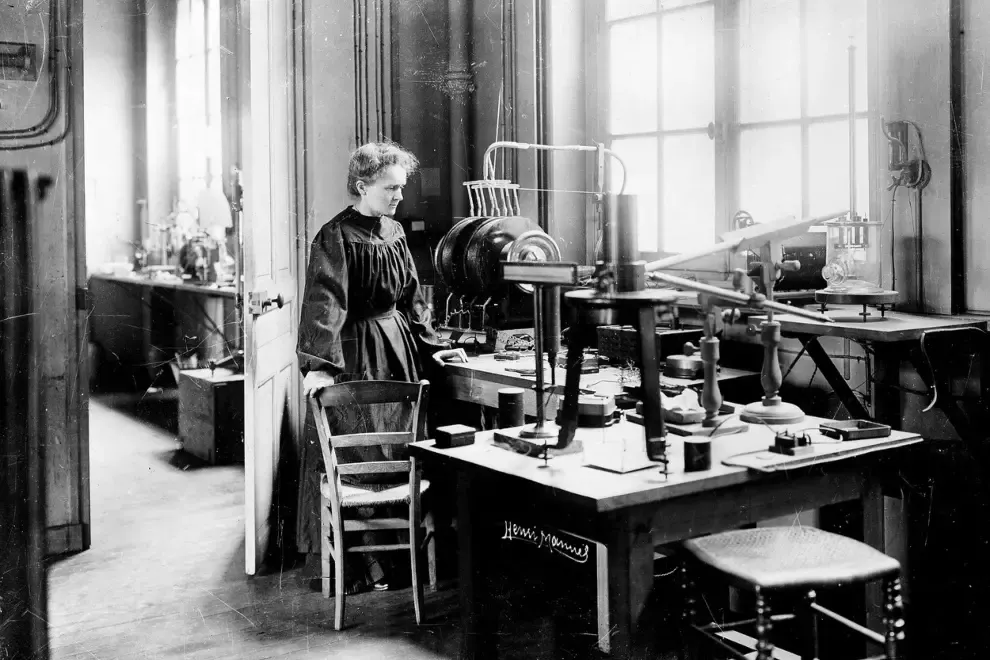
The Curies’ collaboration marked the beginning of one of science’s most remarkable eras. Inspired by Henri Becquerel’s discovery of natural radioactivity, they began their own research on uranium rays. Working under harsh conditions in a makeshift laboratory, they investigated tons of pitchblende ore and, after years of meticulous work, discovered two new elements—polonium, named in honor of Marie’s native Poland, and radium, a highly radioactive element that emitted a mysterious glow.
In 1903, Marie and Pierre Curie, along with Henri Becquerel, received the Nobel Prize in Physics for their pioneering research on radiation phenomena. Marie became the first woman ever to win a Nobel Prize, a historic moment that broke barriers and inspired generations of scientists to come.
However, tragedy struck when Pierre Curie died on April 19, 1906, after a street accident in Paris. Though devastated, Marie continued their research alone. She succeeded Pierre as a professor at the Sorbonne—the first woman ever to hold such a position—and advanced her work in isolating pure radium. Her perseverance was rewarded in 1911, when she received her second Nobel Prize—this time the Nobel Prize in Chemistry—for her discovery of radium and polonium and her groundbreaking work on the nature of radioactive substances. She remains the only person in history to receive Nobel Prizes in two different scientific fields.
Challenges, Myths, and Public Perception
Despite her achievements, Marie Curie faced widespread prejudice and misunderstanding. In the early 20th century, the idea of a woman leading advanced research was still resisted by many. Her personal life was often scrutinized, and myths about her “radioactive glow” and mysterious experiments made her a figure of both admiration and rumor.
In truth, Marie’s glow came not from superstition but from her discovery of radium’s natural luminescence, a phenomenon that fascinated the public but also exposed her to harmful radiation. Even then, she never sought fame or fortune—she refused to patent her radium extraction process, believing that scientific knowledge should serve humanity, not profit.
World War I and Humanitarian Contributions (1914–1918)
When World War I erupted, Marie Curie put her knowledge to immediate use for the sake of humanity. She developed mobile X-ray units—known as “Little Curies”—that brought radiographic imaging to battlefields. These vehicles allowed military surgeons to locate bullets and fractures quickly, saving countless lives.
She personally drove these X-ray units to the front lines, trained doctors and nurses, and supervised over a million soldiers’ treatments. Her tireless service during the war demonstrated that science was not only about discovery—it was also about compassion and action.
Legacy and Later Life (1919–1934)
After the war, Marie founded the Radium Institute (Institut du Radium) in 1914, which became one of the world’s leading centers for nuclear research and medical applications. Under her leadership, the institute trained many of the next generation’s greatest scientists, including her daughter Irène Joliot-Curie, who, along with her husband Frédéric, would go on to win the Nobel Prize in Chemistry in 1935.
Though internationally celebrated, Marie remained humble and committed to her work. Years of exposure to radiation, however, began to affect her health. Despite this, she continued her research until her final days, often refusing to slow down for her own well-being.
On July 4, 1934, Marie Curie passed away in Sancellemoz, France, from aplastic anemia, a disease linked to radiation exposure. She was 66 years old. In 1995, her remains, along with Pierre’s, were moved to the Panthéon in Paris, making her the first woman honored there on her own merits—a recognition befitting her lifelong dedication to knowledge.
Conclusion: A Radiant Legacy That Still Inspires
More than a century later, the legacy of Maria Salomea Skłodowska-Curie continues to illuminate the world of science, education, and humanity. Her discoveries opened new doors in physics, chemistry, and medicine, and her courage broke barriers for women everywhere.
At the Propagation Institute for Advanced Studies, we celebrate Marie Curie as a symbol of relentless curiosity, resilience, and brilliance. Her story reminds us that true discovery begins with passion, and that the light of knowledge—once kindled—can shine across generations.